Wednesday, March 28, 2012

Paul Chambers

Continuing my research on jazz bassists I turn my attention to Paul Chambers. Paul was born in Pittsburg Pennsylvania in 1935. He moved to Detroit where he grew up playing in local gigs around the city until he moved to New York at the age of 20. He initially started out on the baritone and followed with the tuba. He picked up a string bass in 1949 and really dug into his bass training in 1952 when he played with the Detroit Symphony Orchestra. When he got to New York he played with J.J. Johnson-Kai’s quintet as well as George Wallington.


Growing up he idolized Oscar Pettiford and Ray Brown and later became fans of Charlie Parker and Bud Powell. Jimmy Blanton was probably his all-time favorite. In 1955 he joined Miles Davis’s quintet where he played through 1963. When he left Davis’s group he played with pianist Wynton Kelly as well as some freelance work in New York. He did a little classical work throughout his career. In 1952-1955 he studied off and on at Cass Technical high school. He played the symphony there and even played the baritone saxophone on several occasions. He became known for his ability to perform “bowed” solos. Bowed solos had never really been attempted and his ability to work them in as a solo while keeping tempo and keeping the audience interested was second to none. This was really what painted his mark on the jazz culture. A quote from allaboutjazz.com states that “Chambers holds the unique distinction, along with Coltrane and Wynton Kelly, of participating on two of the most important albums in jazz history: Coltrane's Giant Steps, and Davis' Kind of Blue.”[1] Paul Chambers died in 1969 at the age of 33 from tuberculosis.


The blogger software would not let me post it in a video form so here is the link:
http://www.youtube.com/watch?v=c0t1-DxX5Ew

The listening selection I have for this week is a piece from Paul Chambers sextet. It is called Whims of Chambers. It appears to be in a 4 beats per measure time form. Also it seems to be in AABA form. Soon after the introduction we hear a bass solo. Chambers is swinging hard! Drum set is in the background with brushes. Next we go into a piano solo followed by a guitar solo all with Chambers hammering out the bass line in the background. We finish off with a quick piano and drum solo and then the original melody of the song comes back in. Truly a very good piece of music to show off Paul Chambers talents on the bass!

Sunday, March 11, 2012

Walter Page


Another and perhaps the most influential bass player that I have researched is the great Walter Page. Page was an African American jazz bassist that was known for his ability to play behind soloists while remaining in the “four beats to the bar” form. Walter Page was born in Gallatin, Missouri in the year 1900. He attended Lincoln High School and started playing bari-sax and tuba while in high school. He then went to The University of Kansas and continued his study of music there. While he was studying he would go Kansas City on weekends to play with Bennie Moten and also did some gigs with the Dave Lewis band.

After school he was the founder of the Blue Devils, a band centered in Oklahoma City. He experimented with different instruments and more instruments in the rhythm section and basically set the precedent of the modern rhythm sections as we know them today. His changes included a piano, drum set, guitar and a string bass. Before it had been common to see a banjo, drum set and bass horn such as a tuba. The Blue Devils were a little bit different than other bands. They were known as a “commonwealth” band meaning the earnings by the band were split evenly among its members. They were also a band that used head arrangements and often times didn't play with music. Every single member in the band shared the same or similar ideas in music as the others.

As his band grew better and stronger Page offered challenges to Bennie Moten to prove that his band was better. Page wanted to Battle him. Over time as Moten refused to battle, he became rather smart and started to recruit members of Pages band. With little effort he stole Count Basie and several others. Page soon had them replaced with top notch musicians such as Lester Young. As he grew older Page was known for his walking bass lines. A quote from allaboutjazz.com states: “His evenly accented, four-beat “walking” bass lines provided not only a harmonic foundation but a melodic counterpoint in his accompaniments, and he chose notes that enhanced the playing of his bands and soloists.”[1]

Walter eventually joined Count Basie and Bennie Moten in Bennie Moten's band until Bennies death in 1935. He returned to play with Count Basie from then until 1942. Walter Page died in 1957. He was on his was to film part of The Sound of Jazz and he passed away not to long after. His early death limited his impact on jazz but he is still regarded as one of the most influential bassists and band leaders of the swing era.


http://grooveshark.com/s/Them+There+Eyes+number+2/44X3s5?src=5


For my listening this week, I wanted to incorporate a song that featured Walter Page. The song "Them There Eyes" does just that. As you can see I posted the link to it above because I could not find anything I liked on YouTube. Even though this song doesn't have a full band playing, it is a great example of how simple jazz can be. The song starts off with a guitar introduction and goes right into a muted trumpet solo. In the background you can hear Page with his "walking bass line". After some vocals we go into a saxophone solo. This tune seems to be in AABA form. It is a very laid back traditional song. The next soloist is a muted trumpet and the clarity of the "walking bass line" can really be heard well here. A third soloist on an alto sax comes in and we end with a trumpet. This song isn't the most upbeat song out there, but rather very simple. The simplicity allows you to really hear that walking bass line and understand how it helped the musicians solo. It opened up a ton of opportunities for them as musicians and jazz would not be what it is today with out it.

Sunday, March 4, 2012

Jimmy Blanton


The next bassist I have chosen to research is Jimmy Blanton. Jimmy Blanton was an incredibly influential jazz double bassist. Born in October in Chattanooga Tennessee in 1918 he originally learned how to play the violin. He initiated his professional playing violin in Chattanooga as he grew up playing with groups that his mother who played the piano led.


He attended Tennessee State College where he started to play the stand-up bass. After he switched to the string bass he began to play with local bands led by Joe Smith and “Bugs” Roberts. He also played with the State Collegians. After attending college for three years he moved to St. Louis where he joined up with The Jeter-Pillars Orchestra. Two years later as he was playing a “gig” in St. Louis at The Coronado Hotel Ballroom with Miles Davis’ band, Duke Ellington happened to be in town and was very impressed with what he heard from Blanton. A quote from allmusic.com states ““…Blanton's bass could dance freely around the band and phrase like a horn, all without undermining the music's bass foundation.”[1] Duke Ellington immediately signed Blanton to play in his band. For the next two years Jimmy Blanton played as Ellington’s primary bassist in his band. Ellington wrote specific duets for Blanton to play on bass with tenor sax player Ben Webster. As the two became more popular Duke Ellington’s band was given a recording contract with Victor recording. A quote from allaboutjazz.com said “Jimmy Blanton immediately changed the sound and pulse of the orchestra. He had a fluent, buoyant sense of swing, matched with a unique sense of intonation. It was his quality of levitating the sound by his superior musicianship which inspired the other members of the band to rise to the occasion.”[2]


Jimmy Blanton unfortunately did not live a very long life. While on tour with Ellington’s band in Los Angeles, he became very sick and after spending some time in the hospital he was diagnosed with tuberculosis. He fought it for about a year and was eventually moved to the Duarte Sanitarium, close to Los Angeles. He passed away a few months later in the year of 1942 at an incredible young age. Even though he died young, Jimmy Blanton was still one of the most iconic jazz double bass players of his time and greatly influenced “be-bop”and according to www.jazz.com "Blanton contributed more to the jazz legacy before the age of twenty-five than most do in a lifetime."[3]


http://grooveshark.com/#!/search?q=Jimmy+Blanton

For my listening song for this week I picked a song with both Duke Ellington and Jimmy Blanton. I could not find this song on youtube so I copied the link above that should take you to it on Grooveshark. It is the first song on the list entitled Mr. J.B. Blues. This song starts off with just the Duke and Blanton playing a riff over and over again. After they repeat this 8 times and move on to a new riff I started the song over and noticed that it is indeed in AAB form, however they go with a different AAB on the next run. I found it amazing that both musicians both flow really well together but at the same time everything they do individually is relative simple. Jimmy starts to play with a "bow" on his bass around the 2:07 mark. This is the first time I have ever heard a bow used in a jazz song. Blanton seems to push the limits of what most bassists would do but continues to "bail" himself out of it with smooth transitions and phrasing in his playing. While this is a very basic and smooth piece, I think it shows just how talented both Jimmy Blanton and Duke Ellington were quite well.

Sunday, February 26, 2012

Ray Brown


Following along with my trend of bassists I turned my attention to Ray Brown. Ray was a bass player who was born in 1926 in Pittsburgh, Pennsylvania. Havening taken piano lessons from a very young age and struggled to find his way on it. He initially wanted to be a trombone player after decided piano wasn’t for him, but with lack of funds, the trombone was too expensive and he forced to settle for a stand-up bass. In the book Oscar Peterson: The Will to Swing, Brown revealed the main reason for ending his study of piano: "I just couldn't find my way on it. It just didn't give me what I wanted."[1] Soon afterward, Brown, unable to afford a trombone, switched to bass, an instrument provided by the school's music department. After he became proficient on the bass, he played many local gigs in his hometown to make money and despite multiple offers from band leaders he followed his mothers advice and finished high school before traveling on the road. He also played with the well-known group called The Oscar Peterson Trio. Around the age of twenty he purchased a one way ticket to New York City.


Upon arrival in New York City he met and played with Dizzy Gillespie and Charlie Parker and Bud Powell. Dizzy promptly hired Brown as a bassist in his band. He continued to play with Dizzy and even was a part of Dizzies second big band. He left Gillespie’s band in 1947 after he began performing with Ella Fitzgerald. He married her the next year and after adopting a child and naming it Ray Brown Jr. The two divorced in in 1953 due partly to the fact that Ray wanted to pursue his career with Oscar Peterson and he joined up with him for about 15 years. . "During the past decades Brown's sound and skill have remained undimmed, "wrote Thomas Owens, in his 1995 book Bebop: The Music and Its Players."He is an agile, inventive, and often humorous soloist. His arco {bow} technique is excellent, though he seldom reveals it. But he shines most brilliantly as an accompanist[2]. Ray continued playing until his death in 2002. He died in his sleep the night of a concert. Ray Brown is said to have been one of the single most influential people in jazz.


For my listening this week I chose a song by The Oscar Peterson Trio. This song opens with a piano in what appears to be almost an AB form. I really struggle with this but he seems to repeat the same riff several times and then do the same with the next set. This is truly jazz at its best. The trio improved this song and it really stuck and caught my attention. It has your basic blues scales being hammered out on the bass in the background by mister Ray Brown himself. It's hard for me to tell the structure of this song but I notice that Peterson (the piano player) is playing a riff(s), and then playing something that seems to counteract the initial one on the next one following the initial one. Then he will do it with a different set of riffs. I want to say it is in twelve bar blues. Drum set player is laying down a solid swing time. This is a great study song and an overall great listen!


Sunday, February 19, 2012

Stanley Clarke

Continuing my research on jazz bassists I turned my attention to Stanley Clarke. Stanley Clarke has been an incredible standout figure in jazz music the last 50 years and still continues to be today. Born in the 1950s in Philadelphia, he had did not have a rather strong upbringing in music. It is said that he showed up late to a music class the day that instruments were handed out to students and the only thing left was the standup bass. This is how he got his start on bass, eventually graduating from the Philadelphia Musical Academy. Following his graduation he moved to New York City where he began working with many famous band leaders and composers including Dexter Gordon, Art Blakey, Joe Henderson and many more. Shortly after he moved to New York City he joined the band Return to Forever, the leader of the band being well known pianist Chick Corea. According to allmusic, “…Clarke really hit the big time when he started teaming up with Chick Corea in Return to Forever”[1]. Clark also produced probably his best known solo album entitled “School Days” in 1976. 

Coming into the 80s he toured with many notable bands and musicians such as Bela Fleck and Stevie Wonder. Of recently he has turned his focus more towards film scoring and composing having scored movies such as Passenger 57 and The Transporter and many more. Stanley was featured in Los Angeles magazine as one of the 50 most influential people. In 2006 he was awarded with Bass Player magazine’s Lifetime Achievement Award. He was presented it by Victor Wooten and Marcus Miller. Stanley is known best for his individualism on the bass. He places his hand on the electric bass almost just as he would on an upright bass though turned through 90 degrees. When he plays a lead or solo song his fingers wrap up under the bottom two strings such that when he releases on them they slap against the frets causing a percussion smacking sound. This truly is a sound and type of playing that singles Clarke out from any other bassist. He can play the piccolo bass and the tenor bass as well. Stanley Clarke is and will continue to be one of the biggest influences in modern music. 


For my listening this week I chose a classic piece by Stanley Clarke called School Days. This song features Clarke on bass. It appears to be in AAB form and in 4 beats per measure time. It starts out with Clarke on bass for the introduction and the band comes in soon after. It has almost a "techno" feel to it. We get to the solo section and Clarke shows off a bit. He shows his ability to make certain sounds on the bass that others cannot. He truly is very creative. Slowly the band starts to build towards the end of his solo and he goes around for another round. If I understood what I say right on this video he duets for a little bit with the violin or viola that is in the band. In the background this entire time we can hear bits and pieces of a traditional bass sound that another band member is playing. Stanley takes music to a another level and really shows off and the end of this piece. Truly an amazing musician! 


Thursday, February 9, 2012

Charles Mingus


As I my research on bassists, my third bassist is Charles Mingus. Charles was one truly an amazing bassist, pianist as well as a composer. Born in Arizona in the year of 1922 he spent the early part of his life in the “Roaring Twenties”. He grew up in a rather religious family as a lot of his inspiration to play and compose came from the music he heard at church. Around the age of 8 years old he started studying double bass under H. Rheinshagen, the principal bassist for the New York Philharmonic. Some sources say that he even worked and studied with Lloyd Reese, Reese being regarded as a very legendary composer. As his playing and composing matured he found his way to New York. He recorded and played with the best of the best including Charlie Parker and others. He was known for his ability to compose music for mid-sized bands and bass playing. According to allmusic “As a bassist, he knew few peers, blessed with a powerful tone and pulsating sense of rhythm, capable of elevating the instrument into the front line of a band. But had he been just a string player, few would know his name today. Rather, he was the greatest bass-playing leader/composer jazz has ever known, one who always kept his ears and fingers on the pulse, spirit, spontaneity, and ferocious expressive power of jazz.” [1]

Mingus made his presence known in the civil rights movement, but he was more of a hard head on stage. He was not afraid to delay, stop or cancel a concert if the crowd had a poor showing he wasn’t happy with the way something was going. There was even one reported event that in the middle of a concert he slammed the lid of the piano down and smashed the hands of his piano players hands and proceeded to punch his trombonist in the mouth. He truly wasn’t afraid to be himself on stage and intern he developed the nickname “The Angry Man of Jazz”.


My listening piece for this week is a piece called Moanin'. It actually features a baritone sax but the song was just too cool for me to pass up, the introduction to this song is one of the "dirtiest" things I have heard but I love it! Having played this song in high school I was quite familiar with it. I was told that he was drunk when he wrote it by my director but I really am not sure that is the case. It starts off with Ronnie Cuber on the bari with a little solo jam. Then the rest of the band comes in a it keeps getting more and more nasty until they reach quick stop section. They then plan an introduction into a sweet solo section first featuring the baritone sax. As I listen to this song I my legs are swinging and bouncing is many ways as it is truly a catchy tune. Very fast paced song that seems to be in a typical 4 beats per measure. Now we enter a trumpet solo and I can solidly hear Mingus swinging hard on what sounds like a stand up base in the background. The trumpet. After that solo we return to what almost sounds like the beginning of the song where it is finished out.

Monday, February 6, 2012

Marcus Miller


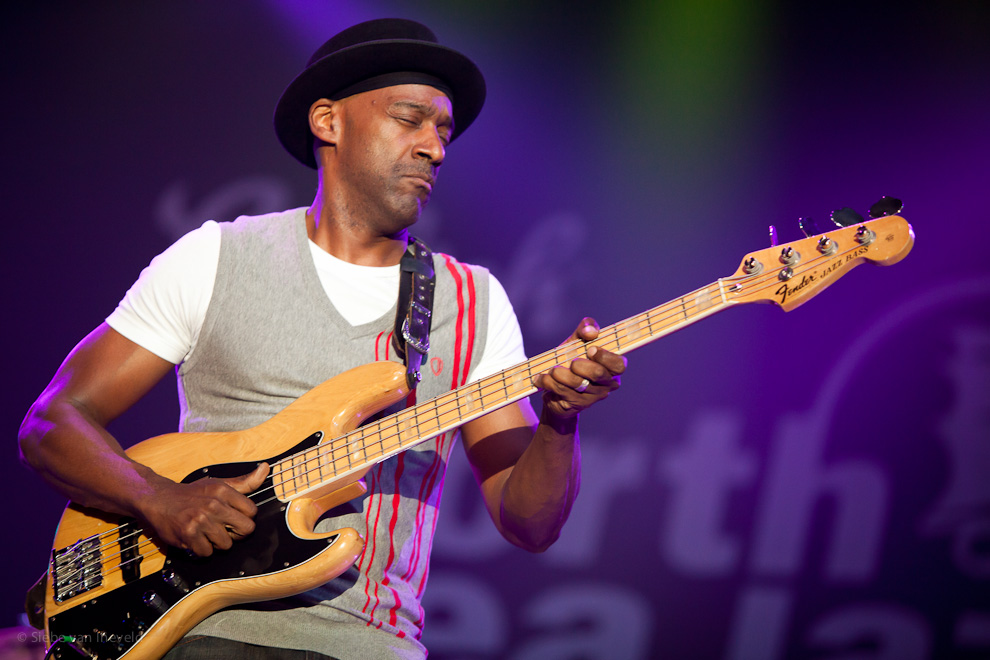
My second blog on the topic of bassists I want to learn more about will feature none other than the one and only Marcus Miller. As I researched Miller I was amazed at the impact he has had on the music industry, both in his playing and composing. I was especially surprised and impressed with some of the people he played with and for. Frank Sinatra, Elton John, Miles Davis, Charles Mingus, Chris Rock, Eddie Murphy and Herbie Hancock are just a few of the names that I came across.


Marcus was born in Brooklyn New York in 1959 and was raised for the most part in Jamaica New York. His family was already into music but his father was a major influence as he was the church organist and choir director. I found it very interesting that he is related to Wynton Kelly. Wynton was a jazz pianist for Miles Davis in the late fifties and early sixties. Around the age of thirteen he was fluent on piano, clarinet, bass guitar and was beginning to compose his own music. A couple of years later he found himself playing bass all over New York City with a variety of bands including flutist Bobby Humphrey and Lonnie Liston Smith who played keyboard. According to allmusic.com “Miller was a fixture as a performer in New York’s jazz clubs before he was even old enough to drive” [1] As he came into adulthood he seemed to be the main man to call in New York as he worked with David Sanborn, Aretha Franklin, Mariah Carey, LL Cool J and many others. In 1981 he joined Miles Davis’ band where he performed with them for two years. In 2001 he was the winner of the Grammy Award for Best Jazz Album of 2001. In his more recent years Miller has turned his focus on film scoring but no matter what he is doing he is always learning and teaching, according to a biography on his website, Miller says "I like to keep things balanced, combining R&B, jazz, funk and movie stuff to help reflect what's happening in our world. I just try to keep challenging myself to continue to grow and get better." [2]


One of my favorite songs played by Marcus is the old Tower of Power classic "What is Hip". This song features Miller on bass. I chose this song to because I felt it is a good representation of the creativity and style Miller plays with. To my best knowledge this piece appears to be in 4/4 (beats/measure) but it almost gives the "cut time" feel. The song starts out with a simple classic bass grove and quickly moves into an upbeat funk chart. Shortly later the alto sax and drum set come in and continue the funk. In the background I notice what appears to be a keyboard that almost sounds like a church organ. Very cool! Now we move into a solo section for the sax and keyboard with Miller hammering the bass for a funky background. He has a way with slapping the bass that is flat amazing! It give me chills just watching how fast his hands are going all while he is having the time of his life. After a great solo by the sax it is Miller's turn to solo and solo he does! After they finish the solo section they move back into a similar feel to the beginning of the song again. This song makes me wish I could play like that, it looks so soothing!